
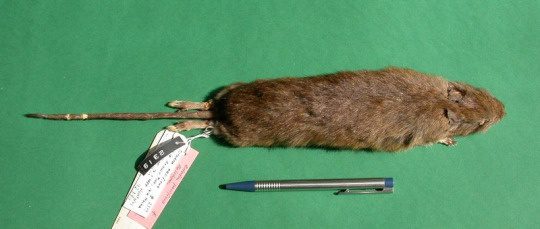
Octodon pacificus, the Pacific degu, belongs to the genus Octodon, in the family Octodontidae. It is known only from Mocha Island, off the Chilean coast, and is listed as Critically Endangered on the IUCN Red List.1
The species was long thought extinct. A report publicised in 2016 described a pregnant female that had died from poisoning.2 In March 2024, CONAF reported the capture and release of four live individuals on Mocha Island.6 These dates should not be confused with its scientific description: Rainer Hutterer described O. pacificus in 1994, using material first collected in 1959.34 It remains one of the least studied members of its genus.
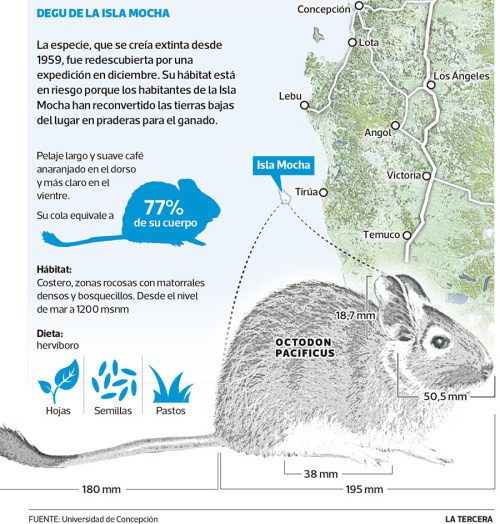
Geographical distribution
Octodon pacificus is endemic to Mocha Island; no mainland population is currently known. Its name refers to the island’s position off Chile’s Pacific coast. Habitat alteration by human activities and introduced animals, including the black rat (Rattus rattus), are conservation concerns.12
Morphology
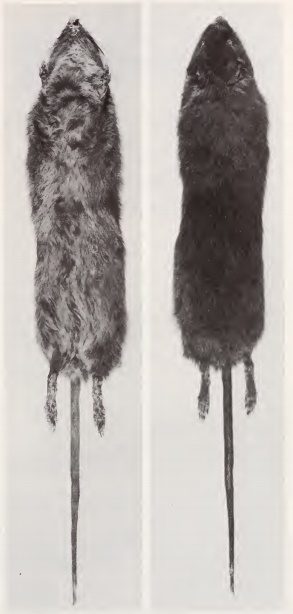
One of the largest members of its genus, O. pacificus can reach approximately 38 cm in total length, including the tail. Descriptions report brown fur with a more orange tinge than the typical agouti coat of Octodon degus, with paler areas on the underside and around the eyes and ears. Its long tail lacks the conspicuous terminal tuft seen in the common degu.3
Taxonomy
A study published in 2017 reported only 0.3% divergence in a mitochondrial DNA sequence between the Mocha Island specimen and animals then identified as O. bridgesi from the nearby Nahuelbuta region. The authors discussed whether the island form might represent variation within a mainland species.5
This hypothesis must be considered in the context of subsequent revisions, including recognition of O. ricardojeda. A 2021 multilocus analysis distinguished O. pacificus from O. ricardojeda. A small mitochondrial difference alone therefore does not establish that the two belong to the same species.7
Sources
IUCN (n.d.). Octodon pacificus. The IUCN Red List of Threatened Species. https://www.iucnredlist.org/species/15090/78321512
Todrop Science (2016). Extinct brush tailed rat aka degu rediscovered in Mocha Island, in Chile. https://todropscience.tumblr.com/post/139234794077/extinct-degu-brush-tailed-rat-rediscovered-in
Hutterer, R. (1994). Island rodents: a new species of Octodon from Isla Mocha, Chile (Mammalia: Octodontidae). Zeitschrift für Säugetierkunde, 59, 27–41. https://www.zobodat.at/pdf/Zeitschrift-Saeugetierkunde_59_0027-0041.pdf
Saavedra, B., Quiroz, D. & Iriarte, J. (2003). Past and present small mammals of Isla Mocha (Chile). Mammalian Biology, 68(6), 365-371. https://doi.org/10.1078/1616-5047-00105
Vianna, J. A., et al. (2017). Record of an alleged extinct rodent: molecular analyses of the endemic Octodon pacificus from Chile. Journal of Mammalogy, 98(2), 456–463. https://doi.org/10.1093/jmammal/gyw193
CONAF (2024). Después de 65 años encuentran al degú en la Reserva Nacional Isla Mocha. https://www.conaf.cl/despues-de-65-anos-encuentran-al-degu-en-la-reserva-nacional-isla-mocha/
Cadenillas, R., & D’Elía, G. (2021). The number of species of degus (genus Octodon) is currently underestimated: An appraisal of species limits and their phylogenetic relationships (Rodentia: Hystricomorpha: Octodontidae). Molecular Phylogenetics and Evolution, 159, 107111. https://doi.org/10.1016/j.ympev.2021.107111