
A secure indoor playpen gives degus additional opportunities to exercise, explore and investigate new activities. Wild degus move over much greater distances than a cage allows. Supervised time in a pen can add variety, although it does not replace a spacious, well-equipped main enclosure.
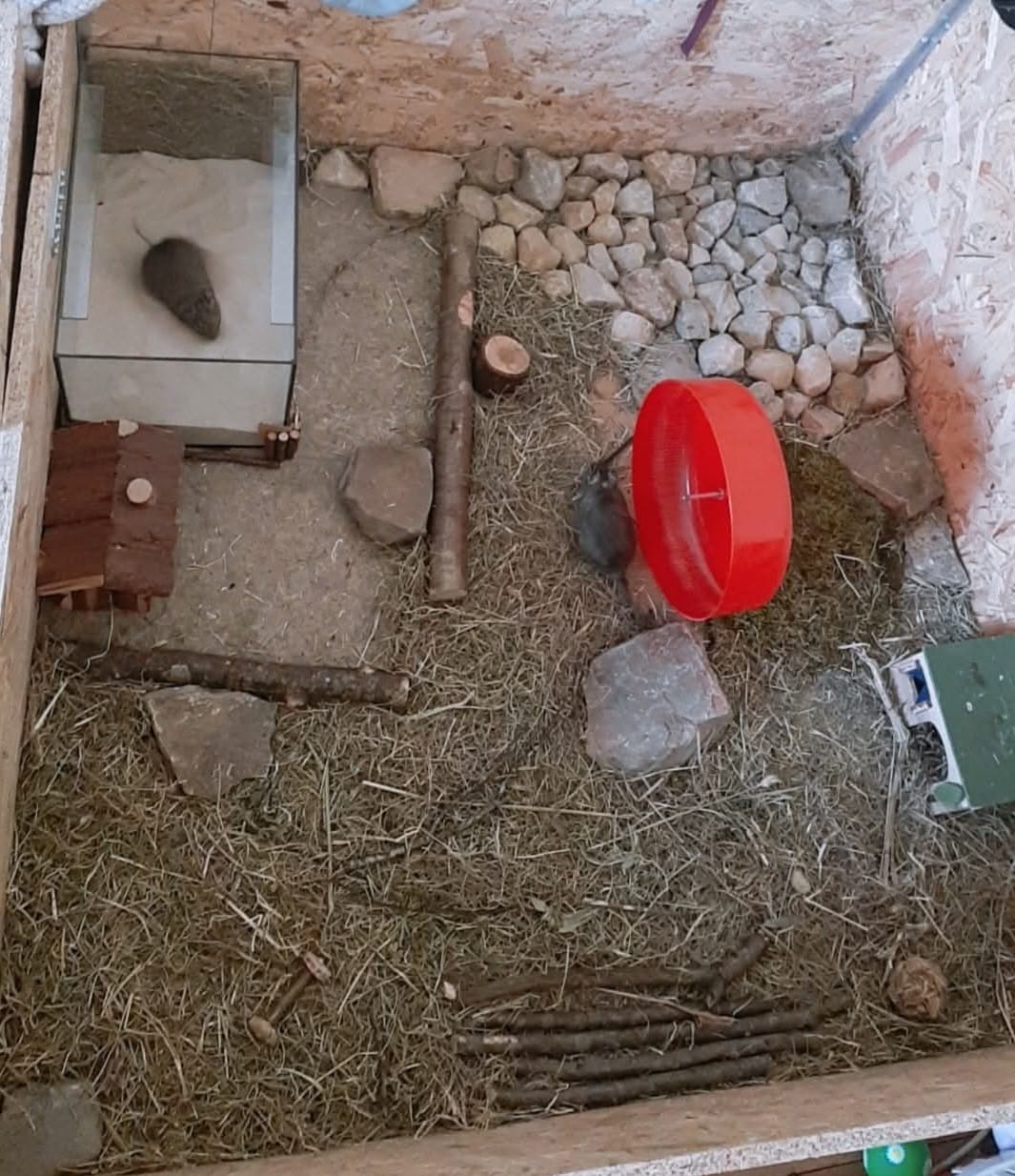

Choosing a suitable playpen
A pen should provide enough room to explore, be easy to clean and have secure, stable barriers. Position it in a quiet area away from electrical cables, household plants and other potentially dangerous objects. A product marketed for rabbits or small rodents is not automatically escape-proof for degus.
Assess every opening, including gaps around doors and panel joints. The French article quoted a maximum bar spacing of 2.5 cm while acknowledging that smaller degus could pass through it. This is therefore not a safe universal limit: openings must prevent the particular animal from passing its head and body through, or becoming trapped. Degus can also climb and jump, so height alone does not establish safety.
Possible designs include:
- An open-topped barred pen. Many degus can climb the bars and escape; assess this before use.
- A pen with a secure roof. This may reduce escapes, although it can make access and human interaction more difficult and may prevent a person from sitting inside.
- A purpose-built pen. Solid wooden boards or suitable clear panels can be arranged to fit the available space. Secure each panel carefully: an unstable wall can fall onto an animal. Consider chewing, joints, ventilation and exposed edges as well as stability.
The French article gives three commercial examples: an EUGAD modular pen, Hamiform Modul’Home and Zolia Jolly. These are examples to assess, rather than confirmation that every configuration is suitable for degus. Check the current materials, openings and fixing system before choosing one.
Safe supervised outings
- Supervise continuously. Stay present and ready to intervene. Never leave degus alone in a playpen, even if they have not previously escaped.
- Provide shelter and activities. Use hides, tunnels, suitable toys, digging boxes and small amounts of hidden food to encourage exploration. See the enrichment guide for further ideas.
- Adapt the session to the animals. Begin with short sessions and watch for signs of fatigue or distress. Some degus find a change of territory stressful. Where a safe connection is possible, allow them to return voluntarily to their familiar cage during the supervised session; this does not mean leaving an open pen available without supervision.

An indoor pen can provide useful exercise and enrichment when the room, barriers and activities are suitable. Secure construction and continuous supervision remain essential. Outdoor outings involve additional hazards and are covered separately in the outdoor exercise guide.
Sources
RSPCA (n.d.). Creating a good home for degus. Animal welfare guidance. https://www.rspca.org.uk/adviceandwelfare/pets/rodents/degus/environment
Botanic (n.d.). Parc pour lapin avec tapis de protection Hamiform Modul’Home. Product description; assess suitability for each degu. https://www.botanic.com/produit/733856/parc-pour-lapin-avec-tapis-de-protection-hamiform-modul-home.html
Zoomalia (n.d.). Enclos modulable Zolia Jolly – Set complet pour lapins, rongeurs. Product description; assess suitability for each degu. https://www.zoomalia.com/animalerie/enclos-modulable-zolia-jolly-set-complet-pour-lapins-rongeurs-p-94373.html