
The purchase or adoption fee is only one part of the cost of keeping degus. A suitable enclosure, ongoing supplies and veterinary care usually represent a much larger commitment. Degus should normally live with compatible companions, so the examples below budget for a pair.
Amounts are in euros and mainly describe a French budget. General supply figures are practical planning estimates, not a survey of current market prices. Veterinary examples were checked on 20 October 2026. Readers elsewhere should obtain local prices rather than convert these figures and assume equivalent costs.
Buying or adopting degus
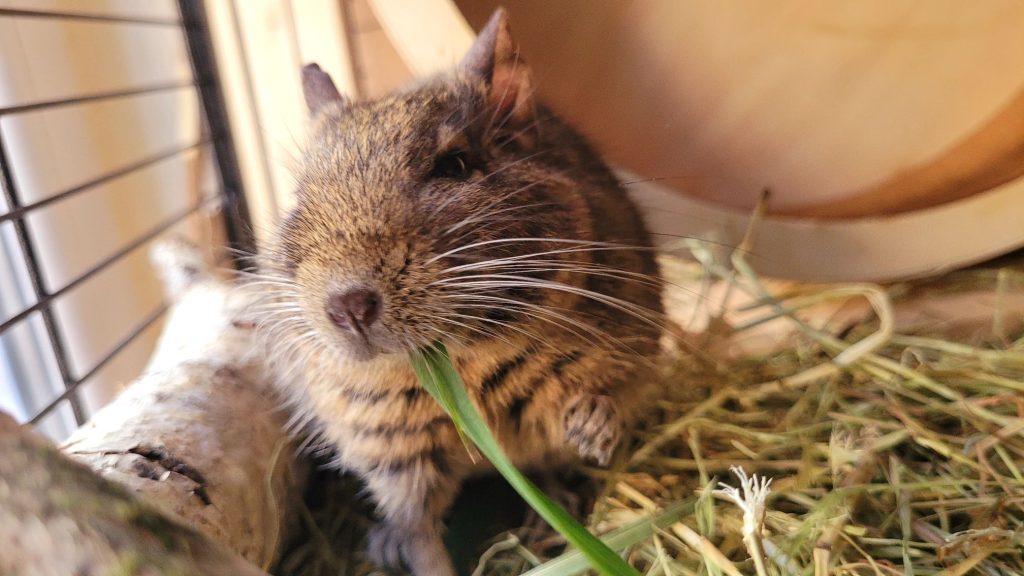
The indicative French purchase range used in this guide is €10–€80 per degu, often around €20–€40. Age, coat colour and the seller can affect the price; unusual colours such as black, chocolate or honey may cost more. These figures are examples rather than a measured national average.
- Pet shops: the original estimate is €20–€80. Ask about the animals’ origin and conditions of breeding and transport. A low price does not establish good welfare.
- Professional breeders: prices can be similar, but veterinary follow-up, hygiene and advice must be assessed rather than assumed. Authorisation requirements depend on the country and the nature of the activity.
- Rescues: the indicative fee is €15–€40. Adoption fees help fund food, housing, veterinary care and further rescues.
- Private rehoming: animals may be offered free or for a fee, subject to local law. French rules do not establish a blanket obligation for every occasional transfer of a non-domestic animal to be free. Regular or commercial activity can trigger additional requirements.
In France, the non-domestic animal transfer certificate, Cerfa 16198, may be used where appropriate; the documents required depend on the animal’s status and transaction. Check the legislation guide and the official guidance before transferring an animal. Rules in the Netherlands and Canada differ by jurisdiction and must not be inferred from French practice.
For a pair, allow approximately €20–€160 in acquisition fees using the broad range above. Read the adoption guide before choosing a source.
Initial equipment
| Item | Indicative initial cost |
|---|---|
| Spacious, secure enclosure | €100–€450 |
| Initial bedding and bath-sand supplies | €150–€200 |
| Bowls, hay provision, water supply, shelters, tunnels and other accessories | €50–€150 |
| Sum of these estimates | €300–€800 |
A relatively inexpensive setup may fall around €300–€400, but the full component range extends to €800. The enclosure must suit the group: a quoted size of 100 × 50 × 80 cm is not a universal minimum for a pair or larger group. Use the CARA guide and assess usable space and layout before buying.
Food, bedding and bath sand
The individual monthly estimates originally used for this budget were approximately €5 for hay, €10 for suitable pellets, €5 for bedding and €10 for bath sand. Applied consistently, these add up to €30 per degu, or €60 per month for a pair. Safe leafy plants may add a few euros, or be obtained through suitable home growing or careful foraging.
Bulk purchasing can lower the cost. A working pair budget of €30–€40 per month may be possible in some households, while the itemised example above reaches €60. These scenarios correspond to approximately €360–€720 per year for two degus, excluding veterinary treatment. They should not be confused with a universal minimum.
Keep hay available and choose an appropriate high-fibre diet. Do not make savings by replacing it with sugary foods or cereal treats. See the feeding guide for suitable foods.
Veterinary costs
The following are advertised French clinic examples, not quotes for every degu. Confirm the species, examination, anaesthesia and medicines included before comparing prices.
| Clinic | Consultation | Male neutering | Female neutering |
|---|---|---|---|
| Clinique de l’Odon | €42, NAC consultation | €151, gaseous anaesthesia; postoperative medicines included according to the clinic’s note | €190, NAC female; gaseous anaesthesia and postoperative medicines according to the clinic’s note |
| Caen Pasteur | €54, small mammal consultation | €116 for rabbits, rodents or ferrets, excluding anaesthesia | €297 for degu or gerbil ovariectomy, excluding anaesthesia |
The Odon clinic lists a six-parameter preoperative blood test at €47.40; Caen Pasteur lists a pre-anaesthetic blood test at €131. Tests are selected by the vet for the animal and procedure, rather than bought as a routine package. Major surgery, dental treatment, imaging, emergency care and hospitalisation can raise the total substantially.
Two consultations at the example rates cost €84–€108 before any tests or treatment. Keep a separate, accessible veterinary reserve of roughly €300–€500 as a starting buffer; an individual emergency can exceed it. A reserve is money kept available, not necessarily an amount spent every year.
A consistent first-year calculation
The €150–€200 initial supply of bedding and sand is part of the annual consumables budget, so it must not be counted twice. The calculation therefore separates durable equipment from supplies used during the year.
| Cost for a pair | Example range |
|---|---|
| Acquisition | €20–€160 |
| Durable equipment: cage and accessories | €150–€600 |
| One year of routine supplies, including the initial stock | €360–€720 |
| Two consultations at the example clinic rates | €84–€108 |
| Total expenditure in this example | €614–€1,588 |
Keep the €300–€500 emergency reserve separate from this spending total. Actual spending depends on what you already own, local suppliers and the animals’ health. An estimate of only €250–€400 for the entire first year would not cover the component costs used here.
Reducing costs while meeting the animals’ needs
- Compare bulk hay and bedding suppliers. A small local farm bale may be inexpensive, but its weight, quality, storage life and how quickly it is used vary.
- Compare larger bags of appropriate bath sand, including delivery. Check the material’s suitability and dust level rather than choosing an industrial product solely by its name or price.
- Buy suitable food in quantities that can be stored dry and used before deterioration.
- Use correctly identified, untreated safe branches and leafy plants. Avoid contamination and poisonous lookalikes.
- Make safe enrichment from suitable cardboard, terracotta and known untreated wood. Inspect edges, openings and chewed parts regularly.
- Use part of the normal ration or safe leaves as rewards. Nuts are rich treats and should remain occasional; cereal snacks are not a suitable cost-saving staple.
Degus commonly live for five to eight years in captivity, with some living longer. Budget for the whole period, including replacements, pet sitting and illness, rather than the purchase alone.
The scientific references below concern degu biology, nutrition and husbandry. In the title “Cost of living in free-ranging degus”, cost refers to energy expenditure, not the price of keeping a pet. The clinic pages support the listed veterinary examples.
Sources
Garduño, B. M., et al. (2025). Octodon degus laboratory colony management principles and methods for behavioral analysis for Alzheimer’s disease neuroscience research. Frontiers in Aging Neuroscience, 16, 1517416. https://www.frontiersin.org/journals/aging-neuroscience/articles/10.3389/fnagi.2024.1517416/full
Hurley, M. J., et al. (2025). Octodon degus: a natural animal model of aging and Alzheimer’s disease. Lab Animal, 54(9), 219–222. https://www.nature.com/articles/s41684-025-01602-8
Gutiérrez, J. R., & Bozinovic, F. (1998). Diet selection in captivity by a generalist herbivorous rodent (Octodon degus) from the Chilean coastal desert. Journal of Arid Environments, 39(4), 601–607. https://doi.org/10.1006/jare.1998.0412
Bozinovic, F., et al. (2004). Cost of living in free-ranging degus (Octodon degus): seasonal dynamics of energy expenditure. Comparative Biochemistry and Physiology Part A: Molecular & Integrative Physiology, 137(3), 597–604. https://doi.org/10.1016/j.cbpb.2003.11.014
Lee, T. M. (2004). Octodon degus: a diurnal, social, and long-lived rodent. ILAR Journal, 45(1), 14–25. https://doi.org/10.1093/ilar.45.1.14
Clinique vétérinaire de l’Odon. (n.d.). Tarifs. https://www.veterinaire-odon.fr/tarifs/
Clinique vétérinaire Caen Pasteur. (n.d.). Nos tarifs. https://veterinaire-caen-pasteur.fr/nos-tarifs
Service-Public. (2026). Peut-on détenir un animal sauvage ? https://www.service-public.gouv.fr/particuliers/vosdroits/F34922