
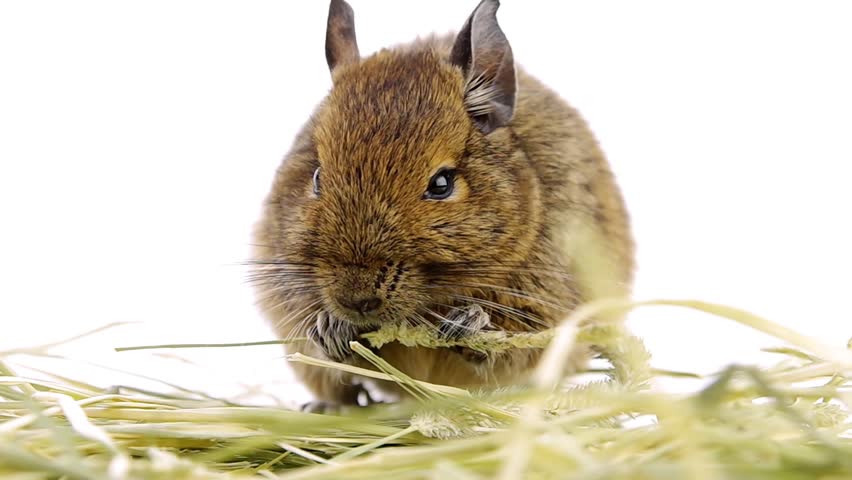
Commercial foods may be labelled for degus alone, degus and chinchillas, or several different rodents such as gerbils and hamsters. Degus and chinchillas share some dietary characteristics, but a food marketed for several species is not automatically suitable for all of them. Claims about digestion or dental health should be assessed against the composition of the food, rather than accepted on the strength of the packaging.
The degu’s diet
Nutrition is central to health. An unsuitable diet can contribute to serious disease, including dental disorders that may require complex treatment and recur if the underlying problems persist.1 In the wild, degus eat a variety of vegetation, chiefly leaves and other fibrous plant material, together with seeds and occasional roots, bark and fruit. Their feeding behaviour is closely connected with their environment. See the natural diet of degus for more detail.
Assessing commercial foods
Dietary composition
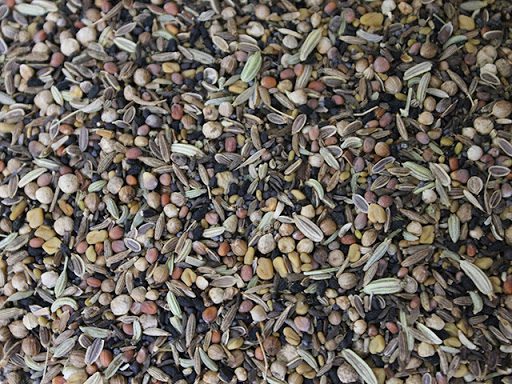
Members of the Degus International Community forum developed the SAB approach with reference to research by Vladimír Jekl and colleagues. The recommendations discussed here combine published findings with practical feeding guidance; they should not all be described as experimentally established requirements.
Calcium and phosphorus balance matters for continuously growing teeth and other tissues. In a study of 300 pet degus presented to one clinic, 60% had acquired dental disease.1 Appropriate nutrition can help reduce nutritional risk, but it does not guarantee that dental disease will be prevented.2 Experimental diets with an inappropriate mineral composition have been associated with tooth elongation and kidney mineralisation.34
The original comparison uses a minimum Ca:P ratio of 1.6:1 and a preferred ratio around 2:1, with approximately 1–1.2% total calcium. These are the guide’s comparison targets. Consider the whole diet, including hay and fresh plants, rather than treating a pellet label as the complete ration.
Other relevant features include fibre, protein, fat and non-structural carbohydrates (principally sugars and starch). A degu diet should provide abundant fibre, moderate protein and limited fat and readily available carbohydrate. The following dry-matter values reproduce the original comparison criteria:
| NSC | Fiber | Protein | Fat | Calcium | Phosphorus | Ca : P |
| ⩽ 30 % | ⩾ 25 % | 15 % to 18 % | 3 % to 7 % | 1 % to 1.2 % | 0.5 % | 1.6:1 minimum 2:1 recommended |
Reading the comparison
Food labels do not always state carbohydrate content. A rough estimate of nitrogen-free extract (NFE) can be calculated from the usual analytical constituents:
NFE (%) = 100 − [crude protein + crude fat + crude fibre + crude ash + moisture].
All values must use the same basis. Do not add minerals separately when they are already included in crude ash. NFE is an estimate that includes starch, sugars and some soluble fibre; it is not an exact measurement of non-structural carbohydrates. Missing label values further reduce accuracy.
Reading these tables: these are historical reference lists, not proof that every listed plant, plant part or commercial product is suitable for degus. Identify plants accurately and account for the part used, preparation, contamination and the individual animal. Entries with identified hazards have been moved to the avoid/verify list; that list also includes precautions where degu-specific safety is unknown. The calcium-to-phosphorus ratio alone cannot establish safety or a balanced ration. Product formulations and hay analyses can vary.
| Product | NFE (%) | Crude fibre (%) | Crude protein (%) | Crude fat (%) | Calcium (%) | Phosphorus (%) | Ca:P ratio |
|---|---|---|---|---|---|---|---|
| Cunipic Naturaliss Chinchilla & Degus Complete | 41 | 19-23 | 14 | 2 | 1.2-1.4 | 0.6 | 2.1 : 1 |
| Versele-Laga Crispy Pellets Chinchilla & Degus | 41 | 20 | 16 | 3 | 1 | 0.5 | 2 : 1 |
| Vadigran Terra Degu | 43 | 22 | 14 | 3 | 0.96 | 0.47 | 2.04 : 1 |
| Supreme Science Selective Degu | 47 | 15 | 14 | 4 | 1 | 0.5 | 2 : 1 |
| Beaphar Care+ Degu (extruded) | 50 | 19 | 13 | 2.3 | 0.88 | 0.35 | 2.5 : 1 |
| JR Farm Grainless Mix | - | - | 13.4 | - | 0.9 | 0.4 | 2.25 : 1 |
| Bunny DeguDream Basic | 42.6 | 20 | 14.3 | 2.8 | 0.65 | 0.4 | 1.6 : 1 |
| Witte Molen Puur Chinchilla & Degu | 45.9 | 20 | 13.6 | 2.4 | 0.5 | 0.3 | 1.6 : 1 |
| Witte Molen Puur Muesli Chinchilla & Degu | 45.9 | 20 | 13.6 | 2.4 | 0.54 | 0.34 | 1.58 : 1 |
| Versele-Laga Complete Chinchilla & Degu | 42 | 20 | 17 | 3 | 0.8 | 0.6 | 1.33 : 1 |
| Versele-Laga Complete (Cavia, Cuni Junior, Chinchilla & Degu) | 44.6 | 20 | 14 | 3 | 0.8 | 0.6 | 1.33:1 |
| Versele-Laga Nature Degu | 46.5 | 16 | 14.5 | 3 | 0.75 | 0.55 | 1.36 : 1 |
| Riga Degu Mix | - | 15.5 | - | - | - | - | - |
| Cunipic Degu Complete Food | 58 | 8.45 | 14.99 | 5.64 | - | - | - |
| JR Farm Degu Special | 51.7 | 14.1 | 13.8 | 2.8 | - | - | - |
| JR Farm Adult Degu Food | 53.9 | 14.4 | 11.6 | 3.1 | - | - | - |
| JR Farm Grainless Complete Degu | 40.97 | 18.4 | 15.3 | 4.5 | - | - | - |
| JR Farm Grainless Health Complete Chinchilla & Degu | 45.6 | 21 | 11.9 | 3.6 | - | - | - |
| JR Farm Grainless Herbs Degu | 41.7 | 19.2 | 15.7 | 4.7 | - | - | - |
| JR Farm Régal | 48.8 | 13.1 | 13.9 | 2.2 | - | - | - |
| JR Farm Schmaus for Degus | - | - | - | - | - | - | - |
| Optima Complete Meal for Degus | 49 | 13 | 15 | 2 | - | - | - |
| Tyrol Degu Mix | 45 | 17 | 15 | 4 | - | - | - |
| Vitakraft Premium Menu Vital Degu | - | 14 | - | - | - | - | - |
| Zolux Nutrimeal Standard Degu | 57.24 | 9.9 | 11.46 | 3.4 | - | - | - |
| Schweizer Nature Degu Food | 53.7 | 14.1 | 13.8 | 2.8 | - | - | - |
| Cunipic Complete Food Degu | 43.77 | 14.41 | 17.36 | 4.31 | 0.94 | 0.54 | 1.7 : 1 |
| Zolux Nutrimeal Degu | 50 | 12.5 | 14.9 | 3 | 0.47 | 0.38 | 1.2 : 1 |
| Zolux Nutrimeal Degu Mix | - | - | - | - | - | - | - |
| Little One Complete Degu | 47.75 | 5 | 15.2 | 3.6 | 0.8 | 0.5 | 1.6 : 1 |
| Little One Green Valley Feed for Degus | 44.4 | 24 | 13.1 | 3.5 | 0.6 | 0.4 | 1.5 : 1 |
| Versele-Laga Complete Crock Herbs | - | - | - | - | - | - | - |
If a product is missing or incompletely described, send a photograph of its composition, analytical constituents and brand name to octodons.lesite@gmail.com. Thank you for helping maintain the comparison.
Download the original comparison in French (PDF).
Interpreting the original product ranking
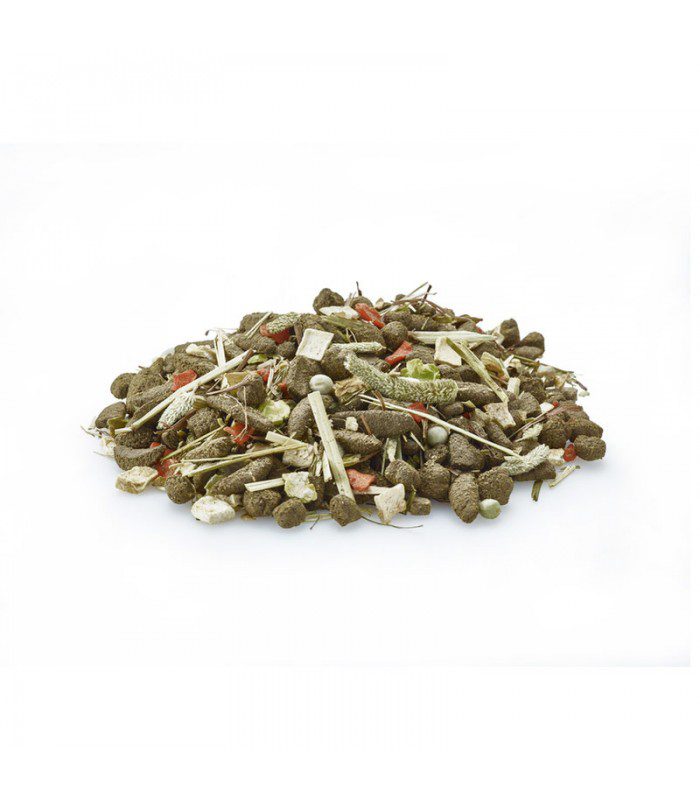
The original comparison favoured the SAB approach and ranked Cunipic Naturaliss Chinchilla & Degus Complet highest among the commercial foods examined, while noting that its fibre content was lower than desired. It next listed Versele-Laga Crispy Pellets Chinchilla & Degus and Vadigran Terra Degu. Supreme Science Selective Degu and Beaphar Care+ Degu were described as having acceptable Ca:P ratios but less calcium and more carbohydrate.
These statements describe the products and formulations assessed for that comparison, rather than a verified ranking of today’s entire market. Formulations change, so compare the current package with the table. The original alternative to SAB was approximately 20 g of the Cunipic product per degu per day; this quantity must be considered alongside the rest of the diet, body condition and individual needs.
Sources
Jekl, V., Hauptman, K., Knotek, Z. (2011). Diseases in pet degus: a retrospective study in 300 animals. J Small Anim Pract, 52(2), 107-112. https://doi.org/10.1111/j.1748-5827.2010.01028.x
Jekl, V. (2021). Degus. In Ferrets, Rabbits, and Rodents: Clinical Medicine and Surgery, pp. 323–333. https://doi.org/10.1016/B978-0-323-48435-0.00023-X
Gumpenberger, M., et al. (2012). Impact of a high-phosphorus diet on the sonographic and CT appearance of kidneys in degus, and possible concurrence with dental problems. Vet Rec, 170(6), 153. https://doi.org/10.1136/vr.100257
Jekl, V., et al. (2011). Impact of pelleted diets with different mineral compositions on the crown size of mandibular cheek teeth and mandibular relative density in degus (Octodon degus). Vet Rec, 168(24), 641. https://doi.org/10.1136/vr.d2012