
Knowing how to distinguish male and female degus is essential, particularly before forming a group. Their overall appearance does not provide a reliable indication of sex; the genital area must be examined. Sex can influence social behaviour, but it does not by itself determine whether two animals will be compatible.
Wild social groups may include one or two males and several females. In captivity, a mixed-sex group requires careful reproductive management. Neutering a male may be an option after discussion with a vet experienced with degus; it should not be treated as a guarantee of compatibility.
How to identify the sex of a degu
Anatomy
Identify the following structures before comparing individuals:
- The anus is the small opening closest to the base of the tail.
- The urinary cone, also called the genital papilla, lies further towards the abdomen and is present in both sexes. Its presence alone does not identify a male.
- In a female, the vaginal opening lies between the anus and the urinary cone. It is usually closed and may appear as a faint horizontal fold.
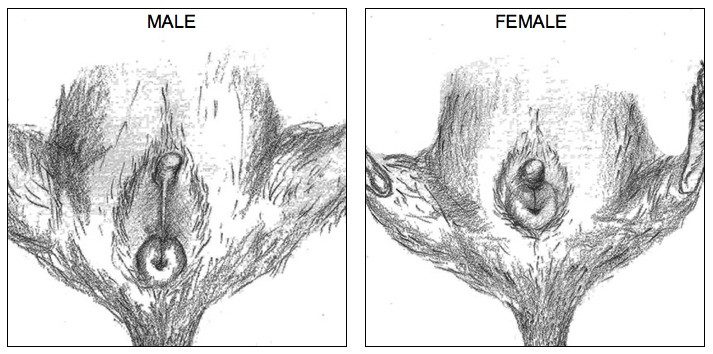
Positioning the degu safely
The genital area is on the underside of the body, near the tail. Observe it without pulling or lifting the animal by its tail: the skin can detach and the resulting injury does not grow back normally. Support the body securely if handling is necessary.
If the degu is not comfortable being held, encourage it onto a transparent container and look from below. A helper can take a clear photograph while the animal leans forwards on a secure ledge or a broad food container. An animal voluntarily climbing the cage bars may also provide a view from below, provided this can be observed without a risk of falling or trapping a limb.
If you are uncertain, ask an experienced vet to confirm the sex. You may also send a clear photograph to octodons.lesite@gmail.com or ask in the partner Facebook group.
Male
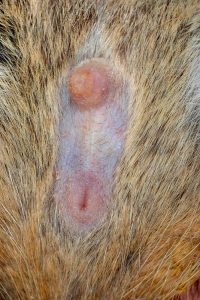
A male has a noticeably greater distance between the anus and the urinary cone, often around 1 cm in an adult. A subtle vertical fold may be visible in this space. The external cone is not an exposed penis. If a penis remains protruded and cannot retract, seek veterinary advice promptly.
Female
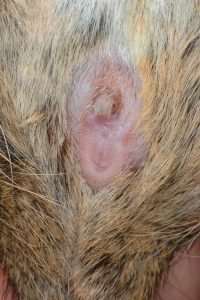
In a female, the anus and urinary cone are separated by only a few millimetres. The vaginal opening between them may be difficult to see when closed. Opening of the vaginal membrane can be associated with the reproductive cycle and is not, by itself, proof of disease. Abnormal discharge, swelling, pain or a change in the animal’s condition warrants veterinary assessment.
See also our guides to handling degus, tail injuries and neutering.
Sources
DIC Team (2013). Sexing Your Degus. Degus International Community. https://forum.degus-international-community.org/viewtopic.php?f=11&t=71
Jekl, V., Hauptman, K., & Knotek, Z. (2011). Diseases in pet degus: a retrospective study in 300 animals. Journal of Small Animal Practice, 52(2), 107–112. https://doi.org/10.1111/j.1748-5827.2010.01028.x