
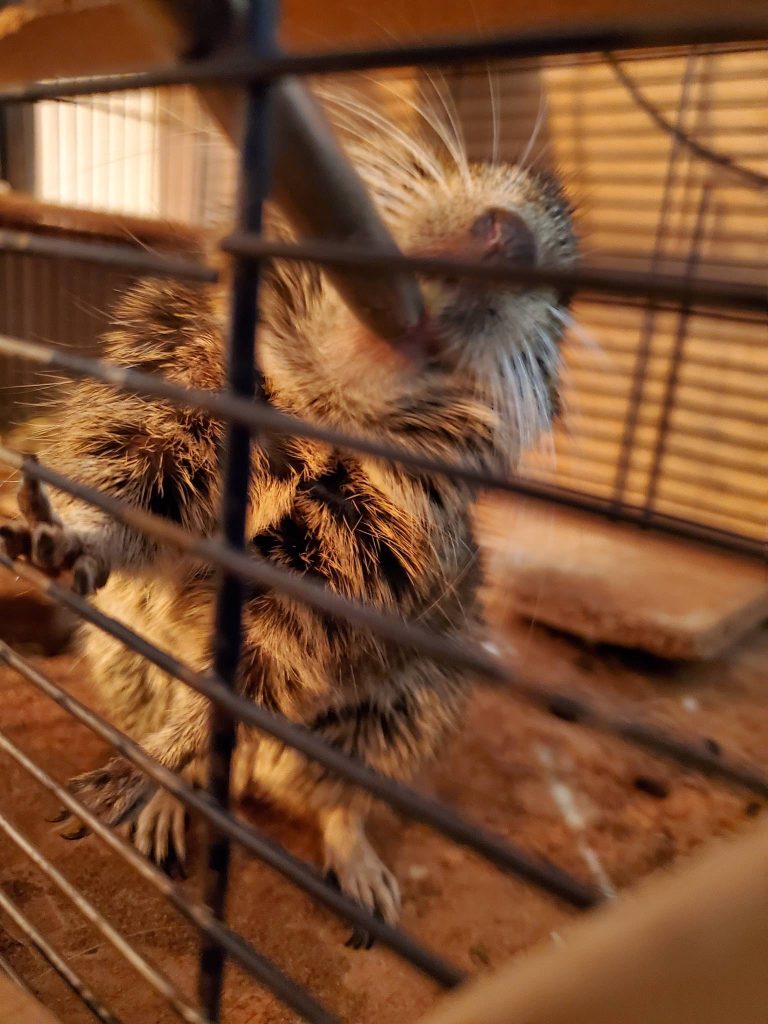
Degus must have access to clean drinking water at all times. Owners often ask whether a bowl or a bottle is preferable. Both can be suitable when properly selected, maintained and accessible. Calling one method “natural” does not establish that it is better for every animal.
A species adapted to a seasonally dry environment
Wild degus experience dry summers and wetter winters in central Chile. Their water balance depends on food, conditions and physiological regulation. In a field study, total water influx averaged 10.3 ± 2.3 ml per day in summer and 40.4 ± 9.1 ml in winter. These are measurements of whole-body water turnover, including water obtained from food, not the volume drunk from a bowl or bottle. The same study found more concentrated urine and greater kidney aquaporin-2 expression in summer. Aquaporins are proteins involved in water transport across cell membranes.
Moisture in food, including foliage of Vachellia caven, contributes to water intake. A laboratory study in 1988 reported a survival time of 13.4 days during water deprivation under its experimental conditions. This is a historical physiological observation, not a safe fasting interval or a husbandry recommendation: pet degus must always have drinking water. Hommel’s dissertation also cites a laboratory-colony average of 23 ml drunk per animal per day; it is not a fixed target, allowance or upper limit for an individual.
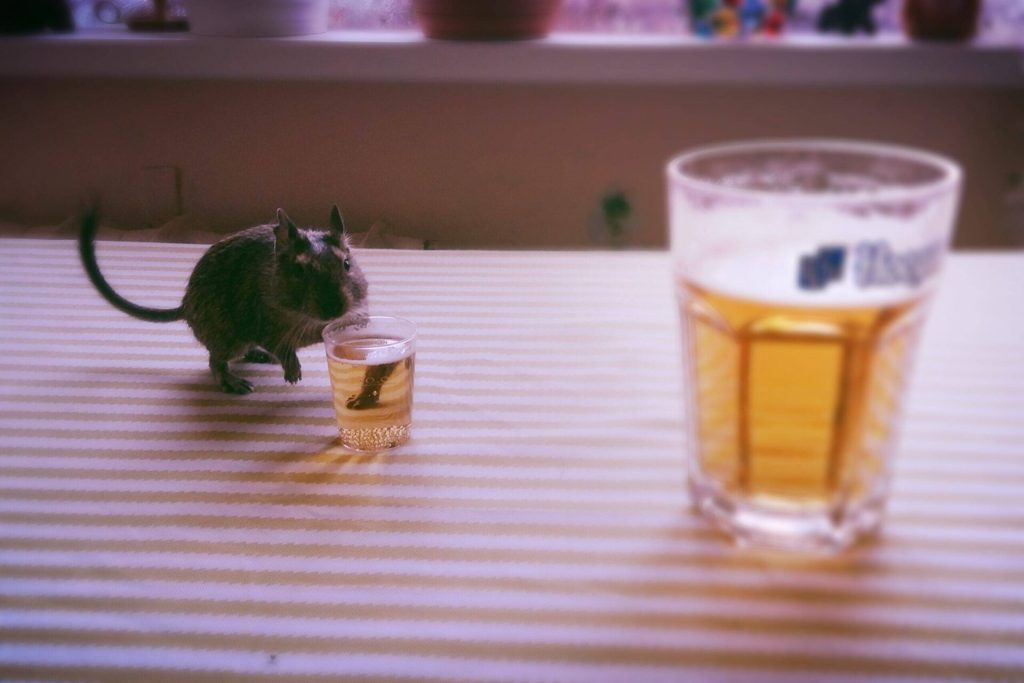
(Never give alcohol to degus!)
Choosing a drinking system
A study involving six degus found variable individual preferences between an open dish and a nipple drinker. The animals could meet their needs using nipple drinkers; the study does not show that every degu has no preference. Observe the animal and provide a familiar system while introducing an alternative.
A water bowl
A suitable bowl should have:
- a low, accessible rim;
- enough weight or a secure fixing to prevent tipping;
- a durable, easily cleaned material, such as suitable ceramic or metal;
- a position that limits contamination by food and bedding;
- fresh water and daily cleaning, with additional changes whenever it is soiled.
Deep containers can present a drowning risk to young pups. Any bowl used around a litter must be assessed for depth and accessibility; use a suitable alternative if the young cannot safely climb out. Wash the bowl with soap and water, using a brush where necessary, then rinse thoroughly. Heat disinfection is only appropriate if the material can safely tolerate it.
Individual needs
A low bowl may be easier to use for an animal with impaired mobility or another medical problem. A vet may recommend offering both systems, particularly when maintaining water intake is important. Kidney disease requires individual veterinary management; the type of container alone is not a treatment.
A water bottle
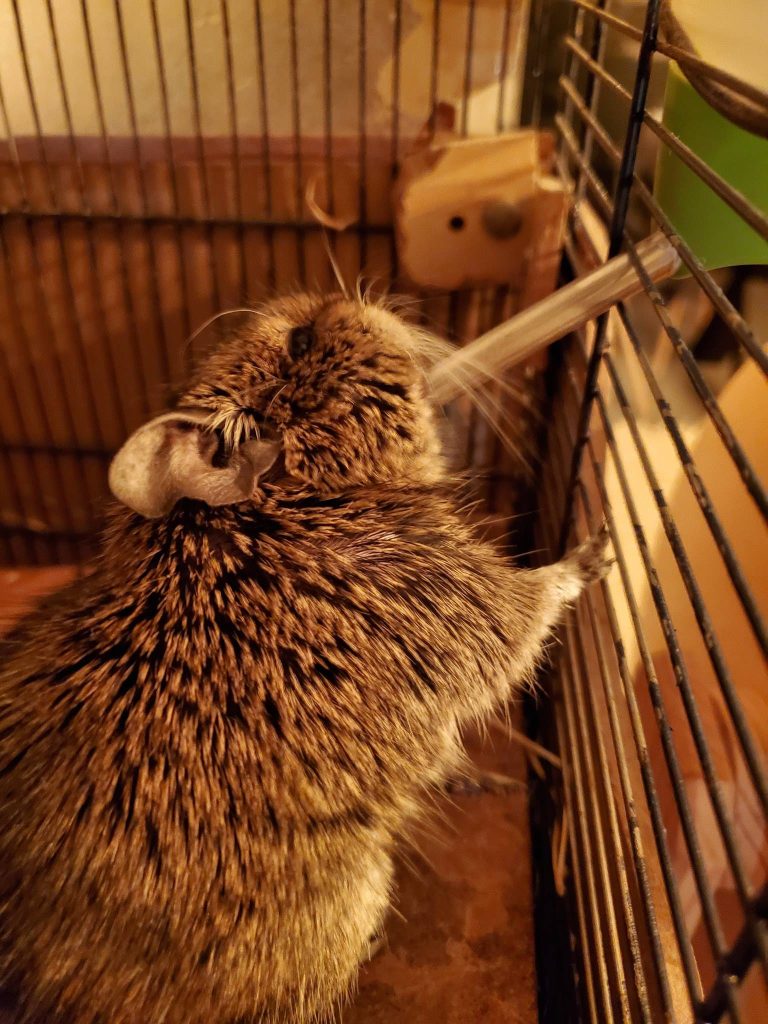
A bottle often limits contamination by loose bedding, but it is not risk-free: it can leak, empty, become blocked or be positioned too high. Check the water level and flow every day. Choose a bottle with a secure fixing, a freely working drinking mechanism and parts that can be dismantled or reached with a cleaning brush. The degu should be able to drink without twisting its neck or struggling against the valve.
The original author reported using a Zolux bottle with a stopper opening successfully for several years. This is an individual experience, not a comparative test or a guarantee of reliability. Assess any model by its practical design, cleanliness and operation.
Comparison
| Criterion | Bottle | Bowl |
|---|---|---|
| Protection from bedding contamination | Often easier, if correctly installed | Requires careful placement and frequent inspection |
| Water intake | Can meet a degu’s needs; check the flow | Can meet a degu’s needs; observe individual preference |
| Material and durability | Depends on the bottle and drinking mechanism | Heavy ceramic or metal may be robust |
| Cleaning | The tube and valve require attention | Usually easy to inspect and scrub |
| “Natural” status | Not a useful welfare criterion on its own | Not a useful welfare criterion on its own |
| Suitability | Suitable when functional, clean and accessible | Suitable when clean, stable and safe for the animal |
The choice depends on the individual degu and the owner’s ability to maintain the equipment. Offering both can provide a useful backup. A sudden change in drinking, an unexpectedly empty container or difficulty using it warrants investigation.
Sources
Hagen, K., Clauss, M., & Hatt, J.-M. (2014). Drinking preferences in chinchillas (Chinchilla laniger), degus (Octodon degu) and guinea pigs (Cavia porcellus). Journal of Animal Physiology and Animal Nutrition, 98(5), 942–947. https://doi.org/10.1111/jpn.12164
Bozinovic, F., Gallardo, P. A., Visser, G. H., & Cortés, A. (2003). Seasonal acclimatization in water flux rate, urine osmolality and kidney water channels in free-living degus: molecular mechanisms, physiological processes and ecological implications. Journal of Experimental Biology, 206(17), 2959–2966. https://doi.org/10.1242/jeb.00509
Cortés, A., Zuleta, C., & Rosenmann, M. (1988). Comparative water economy of sympatric rodents in a Chilean semi-arid habitat. Comparative Biochemistry and Physiology Part A: Comparative Physiology, 91(4), 711–714. https://doi.org/10.1016/0300-9629(88)90954-1
Hommel, D. (2012). Untersuchungen an Degus (Octodon degus) zur Futter- und Wasseraufnahme sowie zur Verdaulichkeit von Nährstoffen bei Angebot unterschiedlicher Futtermittel. Doctoral dissertation, University of Veterinary Medicine Hannover, pp. 11, 21, 30–31. https://api.deutsche-digitale-bibliothek.de/binary/d1b64edc-d762-412d-8058-55fdc5c9f3f8.pdf
Colby, L. A., Rush, H. G., Mahoney, M. M., & Lee, T. M. (2012). Degu. In The Laboratory Rabbit, Guinea Pig, Hamster, and Other Rodents, pp. 1031–1053. Academic Press. https://www.sciencedirect.com/science/article/pii/B9780123809209000444